
8-Cylinder Radial Stirling Engine
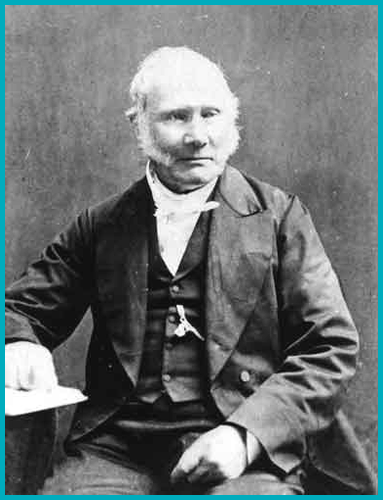
The Stirling engine was first invented in 1816 by Robert Stirling as a safer and more efficient alternative to the steam engine. It is a closed-cycle regenerative heat engine which operates on the principle of thermal expansion and contraction of a sealed gas.
Stirling engine designs are based on three main configurations – Alpha, Beta, and Gamma. Each configuration arranges the pistons and cylinders differently to move gas between the hot and cold zones.
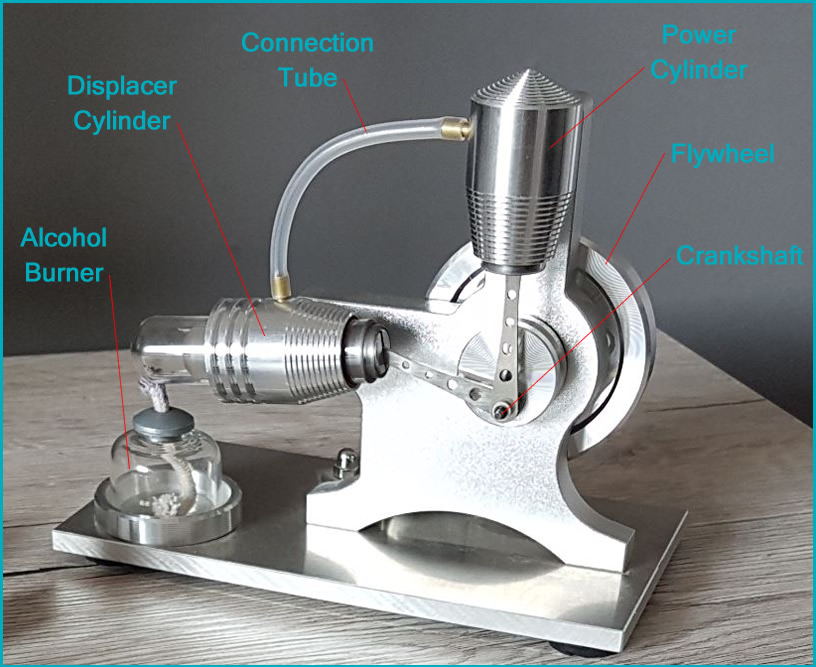
The illustration shown below is a typical Gamma-type configuration. The engine consists of two cylinders, which are the displacer cylinder and the power cylinder i.e., hot and cold. Both cylinder volumes are connected via a tube so there is a fixed amount of working air inside. The pressure of this air can be altered by adding or removing heat.
The displacer piston is a loose fit inside the glass cylinder which allows air to flow around it but has a sliding fit in the lower section of the cylinder, whereas the power piston is a close sliding fit inside its cylinder. The pistons have connecting rods which are attached to a single crankshaft, with the displacer piston being phased 90° ahead of the power piston.
There is a flywheel connected to the crankshaft to aid engine momentum and an alcohol burner for the external heat source.
The Stirling engine has four phases which are heating, expansion, cooling and compression.
Once the alcohol burner is lit the air inside the displacer cylinder starts to expand as it is heated up, which moves the displacer piston. Some of the heated air passes around the loose-fitting displacer and flows through the connection tube into the top of the power cylinder, this higher-pressure air will drive down the power piston.
Because the power cylinder is cold, the hot air is instantly cooled down which results in a pressure drop. This means less work is required from the power piston on the upward stroke to compress the cooler air back into the displacer cylinder, flywheel momentum helps to overcome resistance and the cycle can begin again.
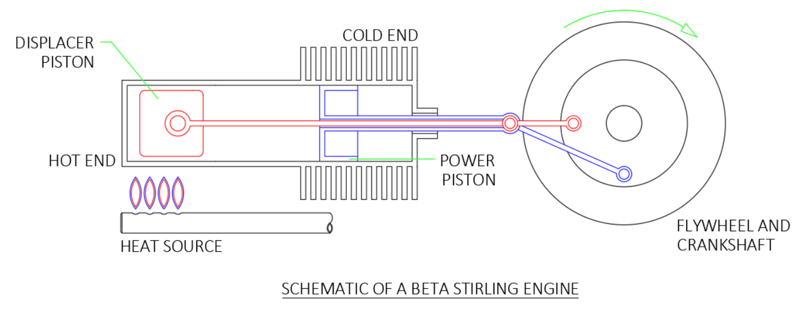
The Beta Stirling engine works in the same way as the Gamma Stirling engine, but the cylinder and piston geometry is different. The power piston and the displacer piston are located inside the same cylinder. There is a sealed bore going through the power piston, which allows the smaller diameter displacer piston drive rod to slide straight through on the same axis. A mechanical linkage connects both pistons to a crankshaft which sets the timing, keeping the displacer moving 90° ahead of the power piston.
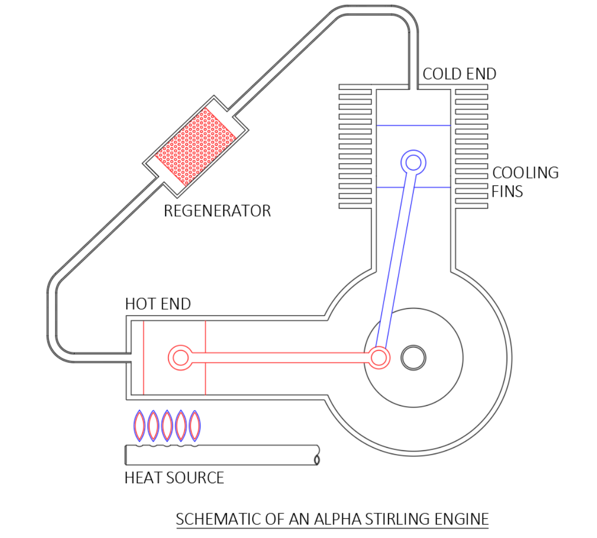
The Alpha Stirling engine uses the same thermodynamic cycle as the Gamma and Beta Stirling engines but does not have a “displacer”, instead it has two power cylinders, both with close sliding fit pistons. There is a hot cylinder which is heated by an external source and a cold cylinder which often has external cooling fins. These engines typically have a regenerator which stores and releases heat energy as the working gas moves back and forth. The pistons are mechanically linked to the same crankshaft at a 90-degree angle.
As there is no combustion taking place all these Stirling engines are very quiet and virtually emission free, and the ability to use the same gas repeatedly to generate power can prove to be more efficient than internal combustion engines.
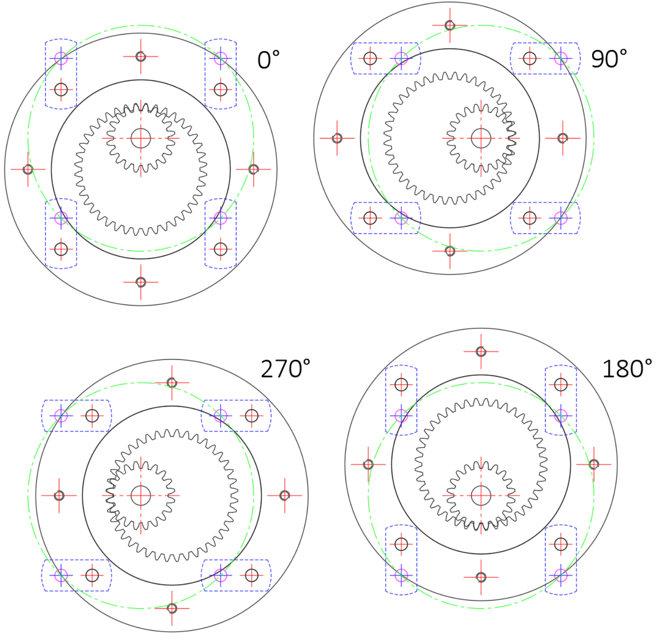
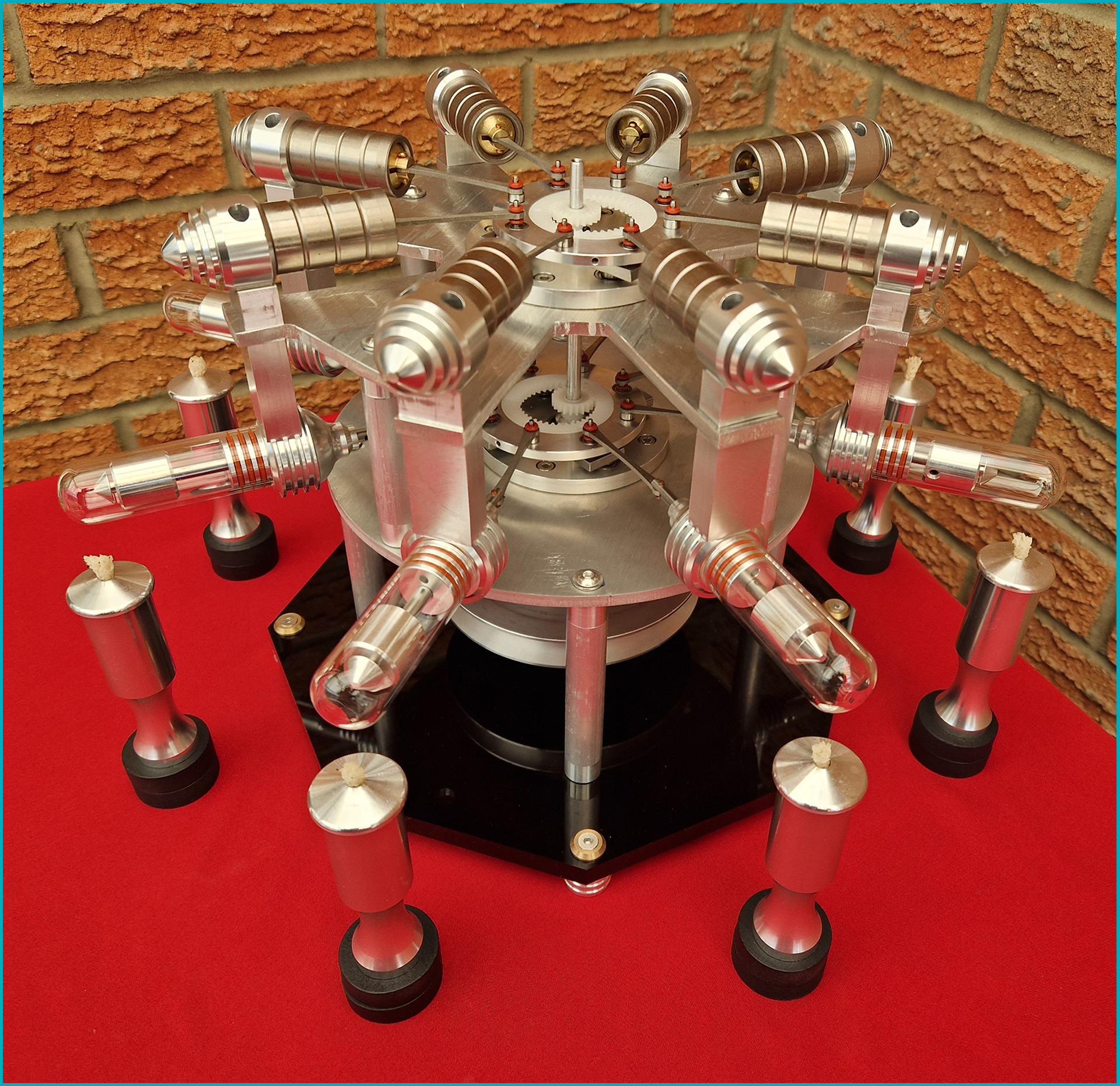
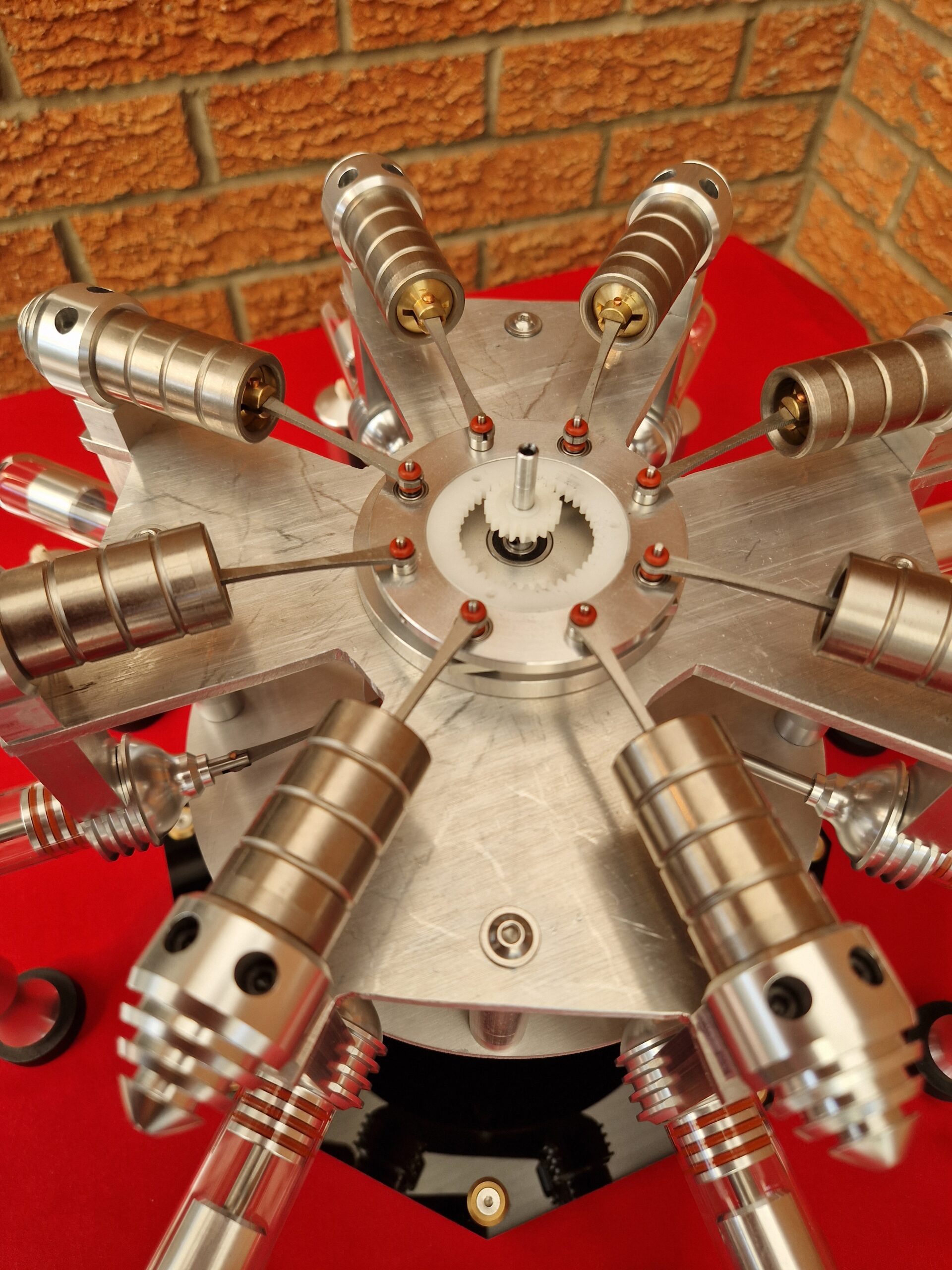
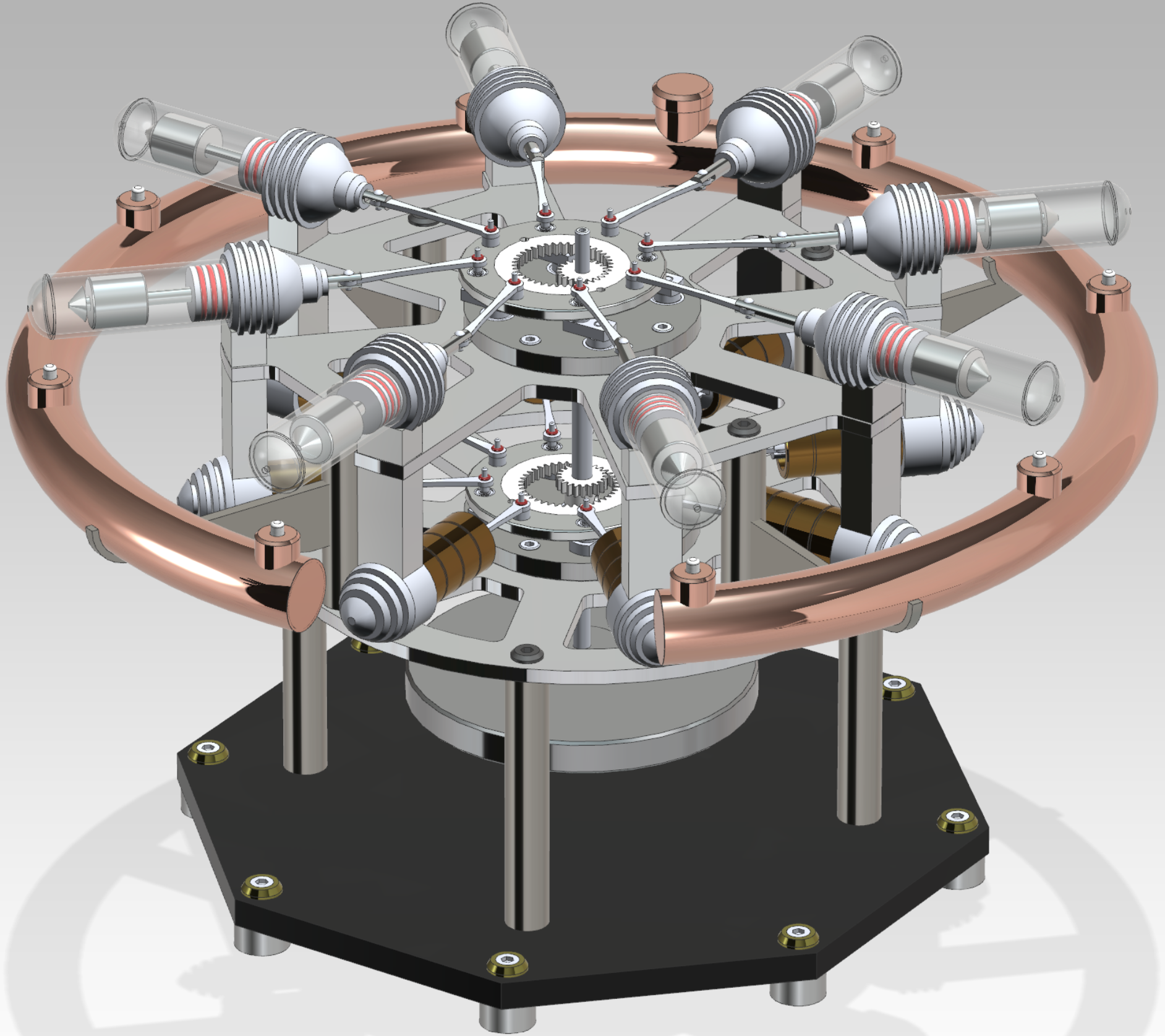
The Teratek Radial Stirling engine is a Gamma-type design. There are 8 equally spaced displacer cylinders and 8 equally spaced power cylinders arranged radially around a vertical shaft. Each piston is connected via their respective connecting rod to an offset internal gear ring which is in constant mesh with a spur gear fixed to the shaft.
There are 2 internal gear rings and each gear ring is located on 4 cranks which constrain the gear rings to an orbital motion, which in-turn rotates the spur gears in the opposite direction. These 8 guide cranks act like anchor points and manage the piston inertia forces, ensuring radial stabilization and correct alignment of gear teeth interface. The displacer gear ring is phased 90° ahead of the power gear ring.
Aluminium spacers connect the displacer cylinders to the power cylinders and ensure correct alignment with both internal gear rings. A small diameter bore runs through each spacer for the sealed working air and requires O-rings for an airtight fit.
8 Burners filled with Ethyl alcohol provide the external heat source. Once the burners are lit it takes around 30-45 seconds to heat up sufficiently so that the power gear ring can be spun in a clockwise direction to get the engine running under its own power. It is worth noting that the position of the flame relative to the longitudinal axis of the glass cylinder will affect the engine performance.
Variable Phase Tuning: As stated, the displacer gear ring is currently phased 90° ahead of the power gear ring, but Stirling engines can be phased between 70° and 120°. The phase angle on this engine can by adjusted by raising the vertical shaft to disengage the gears and then simply moving the displacer gear ring clockwise or counterclockwise by ‘X’ number of teeth, before lowering back the shaft for gear engagement.
My original design had the power cylinders on the bottom deck to keep them as cool as possible, but mounting the alcohol burners higher up required support brackets which wasn’t aesthetically pleasing, an alcohol burner ring would be an option. The current location of the power cylinders are far enough away not to be affected by the radiant heat from the alcohol burners. The original design also had the gear rings phased at 180° to provide a balanced engine, however this required small bore piping to be routed from each displacer cylinder to a power cylinder positioned 90° from their axis. The increased working air volume (pipe length) would have probably reduced the overall performance.
The engine runs very smoothly with little noise and minimal vibrations as can be seen in the short video clip below. A reasonably heavy 120mm diameter flywheel is required to maintain the engine inertia.
This is an experimental design showcasing the use of internal gear rings for converting the reciprocating movement of pistons into rotational motion, replacing traditional crankshaft design. The efficiency and power output can be considerably improved by changing various parameters like the volume of the working air, cooling of the power cylinders, adding a regenerator and alternative heat sources.
Teratek Stirling Engine Orbital Drive Gearing –
The Stirling engine fell out of favour by the early 20th century as it simply couldn’t compete with the power to weight and faster speed changes of the internal combustion engine. However, it is worth remembering the advantages they still offer, which include – low emissions, low maintenance, low manufacturing costs, high efficiency, good reliability and quiet operation. Also, the external supplied heat can come from various energy sources like solar, geothermal, biomass and industrial waste heat which is a real benefit in today’s strive for greener energy.
For enquiries about this engine please email – info@teratek.co.uk – Thanks for stopping by, Mike.